Why Domain Registration Data Is a Research Signal
When a company launches a product, enters a new market, or rebrands, it usually registers domains first. The website comes later. The marketing campaign comes later still. Domain registration is often the earliest public signal that something is happening.
This makes domain data useful beyond security and sales. Market researchers use registration trends to identify emerging industries. Compliance teams use WHOIS records to verify business ownership and screen third parties. Competitive intelligence analysts track how rivals expand their domain portfolios over time.
Unlike surveys or self-reported industry data, domain registrations are timestamped, structured, and publicly sourced. You can count them, filter them, and track them over time with reproducible methods.
The research use case page describes how analysts apply this data across industries.
Market Research Use Cases
Domain registration volume and keyword patterns reveal market activity that other data sources miss or report with a lag.
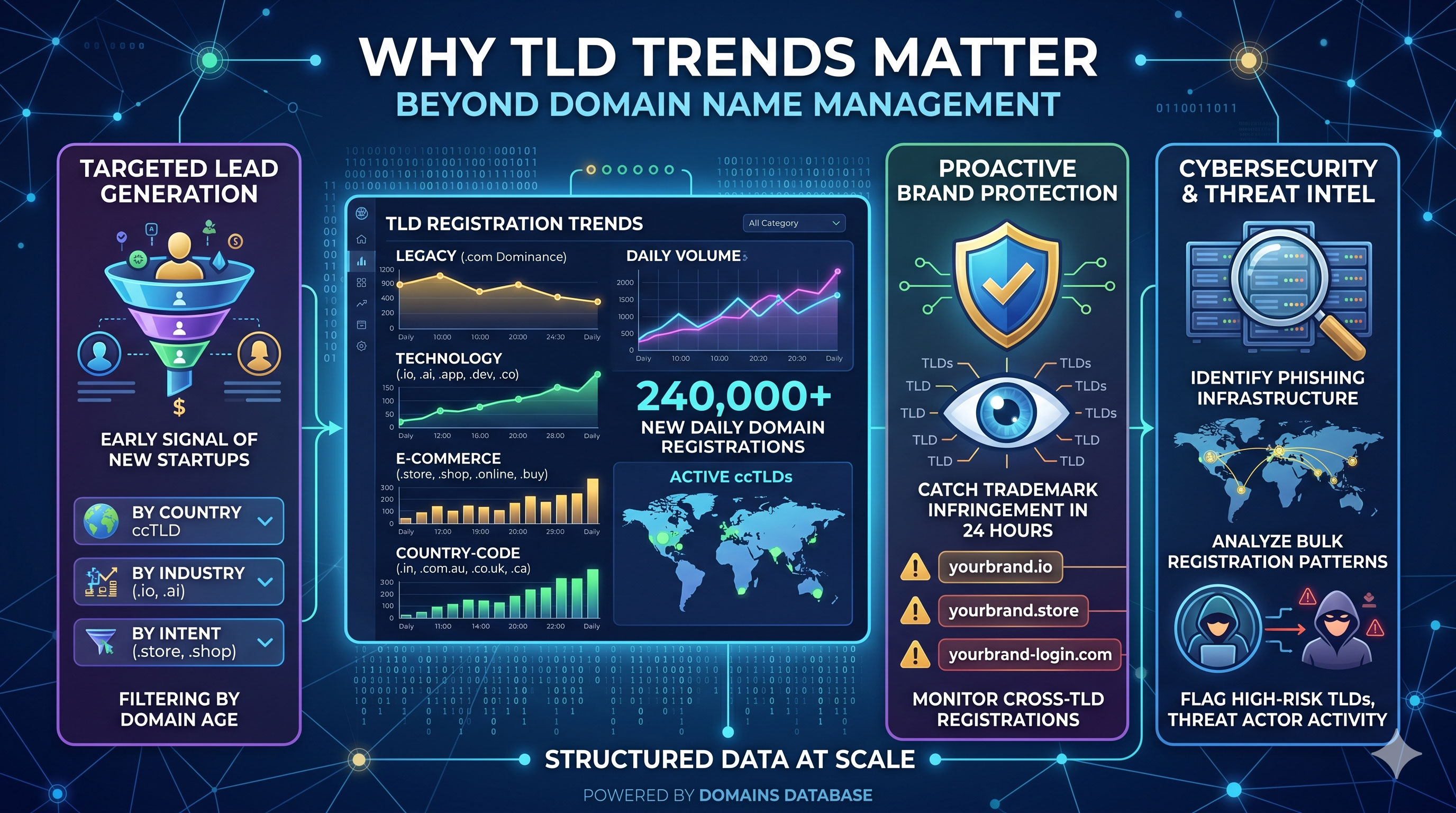
TLD trend analysis - Track which extensions are growing. Spikes in .ai or .io registrations often correlate with technology sector activity. Growth in .store or .shop signals e-commerce expansion. Country-code TLD registration patterns reveal geographic market entry. The daily Domains Database feed covers 1,601 TLDs, making broad trend analysis practical from a single CSV file.
Keyword cluster analysis - Filter daily registrations for industry-specific terms. A sudden increase in domains containing solar, ev-charging, or telehealth in a given month is a quantifiable signal of sector interest. Researchers at universities, think tanks, and market research firms use this approach for trend reports and academic papers.
Competitor domain portfolio tracking - Map which domains a competitor registers over time. New product launches, geographic expansion, and brand acquisitions often appear in domain registration data before press releases. Cross-reference registrant organisation names in the WHOIS Database to group domains by owner.
Market sizing - The complete registered domains list contains 319M+ active domains across all major TLDs. For niche sizing (how many domains contain a specific keyword or use a specific TLD), this dataset provides a comprehensive baseline.
Compliance and Due Diligence Workflows
Compliance teams need verifiable facts about business relationships, not assumptions based on a company's website alone.
Vendor and partner screening - Before onboarding a supplier, verify that the domain they provide actually belongs to them. A WHOIS lookup confirms registrant organisation, registration date, and registrar. Discrepancies between a vendor's claimed identity and their domain registration record are a standard red flag in third-party risk assessments.
Ownership verification - WHOIS records show who registered a domain, when, and through which registrar. For M&A due diligence, tracing domain ownership history through the archived WHOIS database reveals whether a target company's web properties have changed hands or been registered recently (a potential sign of shell company activity).
KYC-style domain checks - Financial services and regulated industries increasingly include domain verification in customer onboarding. Confirming that a business domain was registered before the company claimed to exist, or that the registrant email matches known company contacts, adds a layer of validation to standard KYC procedures.
Sanctions and watchlist cross-referencing - Registrant names and organisation fields in WHOIS records can be cross-referenced against sanctions lists and adverse media databases. Focused country packs are available for India, the United States, and Australia, where registrant contact data availability is often higher. Browse all country-wise WHOIS databases on the overview page.
For a full reference on which fields appear in WHOIS records and when they may be empty, see Understanding WHOIS Data Fields in the knowledge base.
WHOIS Privacy in 2026: What Still Works for Research
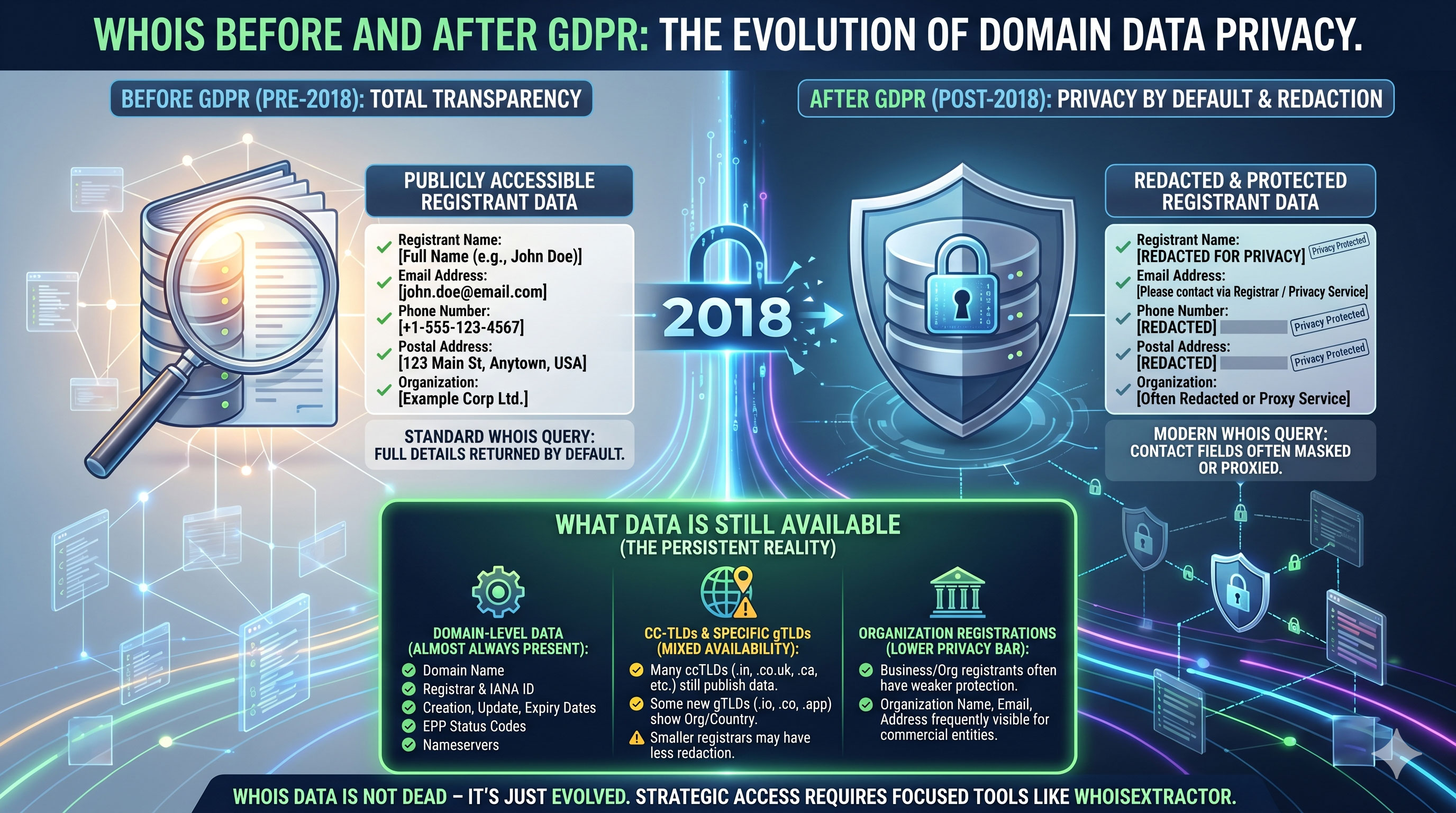
GDPR and registrar privacy policies changed WHOIS significantly after 2018. Many people assume registrant contact data is gone entirely. That is not accurate.
Domain-level data (creation date, expiry date, registrar, nameservers, EPP status) is available for essentially all domains regardless of privacy settings. Registrant contact data availability varies by TLD, registrar, and registration type. Country-code TLD databases and organisation registrations retain more contact detail than generic .com domains registered through privacy-enabled registrars.
Our detailed breakdown of what persists and what is redacted is in the blog post WHOIS Privacy and GDPR in 2026. For research and compliance workflows, the practical takeaway is: use domain-level data for all domains, use registrant contact data where available, and never treat empty fields as confirmed absences.
Daily Data vs Archived Data
Different research questions need different time horizons.
Daily feed (current activity) - The Domains Database daily API delivers 240,000+ newly registered domains per day. Use this for trend monitoring, competitor tracking, and compliance screening of recent registrations. The API supports fetching up to 4 days back via the date= parameter, which covers short gaps in automated pipelines. See the Newly Registered Domains API docs for endpoint details.
Daily Full WHOIS (registrant details) - The Daily Full WHOIS Database is updated every 24 hours with newly registered domains and updated records, including registrant contact fields where publicly available. Pair this with the domain list feed when you need both discovery and ownership detail.
Archived WHOIS (historical analysis) - The archived WHOIS database covers registration records going back several years. Use this for longitudinal studies: how has a market's domain registration volume changed over time? When did a specific company first register its domains? Has ownership of a domain changed hands?
Complete domain list (market snapshot) - The all registered domains list provides a point-in-time snapshot of 319M+ active domains. Ideal for batch analysis in Python, R, or statistical tools rather than manual review.
Working With CSV Data at Scale
All WhoisExtractor data is delivered as CSV files in ZIP format. This is deliberate. CSV integrates with the tools researchers and compliance teams already use:
Excel and Google Sheets - Open any daily file directly for manual review, filtering, and pivot tables. Suitable for teams reviewing dozens to hundreds of records per day.
Python and R - Load CSVs with pandas or readr for programmatic filtering, statistical analysis, and visualization. The consistent schema across daily files makes time-series analysis straightforward.
Tableau and Power BI - Import CSV data for dashboard visualization. Track registration volume trends, TLD distribution, and keyword frequency over time.
Database import - Load daily files into PostgreSQL, MySQL, or SQLite for SQL-based querying and joining with internal datasets.
For country-specific research, dedicated packs are available for India, the United States, and Australia. Each reflects the registration data publicly available from those respective registries. See the country-wise WHOIS overview to compare all packs.
Combining WHOIS and Website Data
WHOIS records tell you who registered a domain. Website data tells you how that domain presents itself publicly. For compliance investigations, both sources together provide a more complete picture.
The Website Database daily details feed collects email addresses and phone numbers from live business websites. During a due diligence review, cross-reference:
- WHOIS registrant email vs website contact email (do they match?)
- WHOIS organisation name vs website company name (consistent branding?)
- Domain registration date vs website content (does the site content match the claimed business age?)
Discrepancies between registration records and live website content are common investigation triggers in compliance workflows. The Website Database page describes all available feeds and formats, including the complete website domain list.
Getting Started
Domain data for research and compliance does not require custom scraping or individual WHOIS queries at scale. WhoisExtractor delivers structured, daily-updated CSV files ready for import into your existing tools.
View all database options and pricing on the pricing page. The WHOIS Database, Domains Database, and Website Database are available individually or as bundles depending on your research scope. You can also download sample WHOIS files before subscribing.
For academic institutions, market research firms, or compliance teams with specific volume or format requirements, contact the team or open a support ticket. Explore the full research use case for workflow examples, and read Getting Started with the API if you plan automated delivery.