Why TLD Trends Matter Beyond Domain Name Management
Most people think of TLD selection as a one-time decision when registering a domain. But for businesses that work with domain data - registrars, hosting providers, brand protection teams, lead generation agencies, cybersecurity researchers - understanding registration trends across the entire TLD landscape is a core intelligence function.
Registration volume by TLD reveals which markets are growing, which industries are expanding online, and where threat actors are operating. The WhoisExtractor Domains Database tracks these patterns daily across 1,601 TLDs, delivering structured CSV files that make this analysis tractable at scale.
The Shape of Daily Domain Registrations
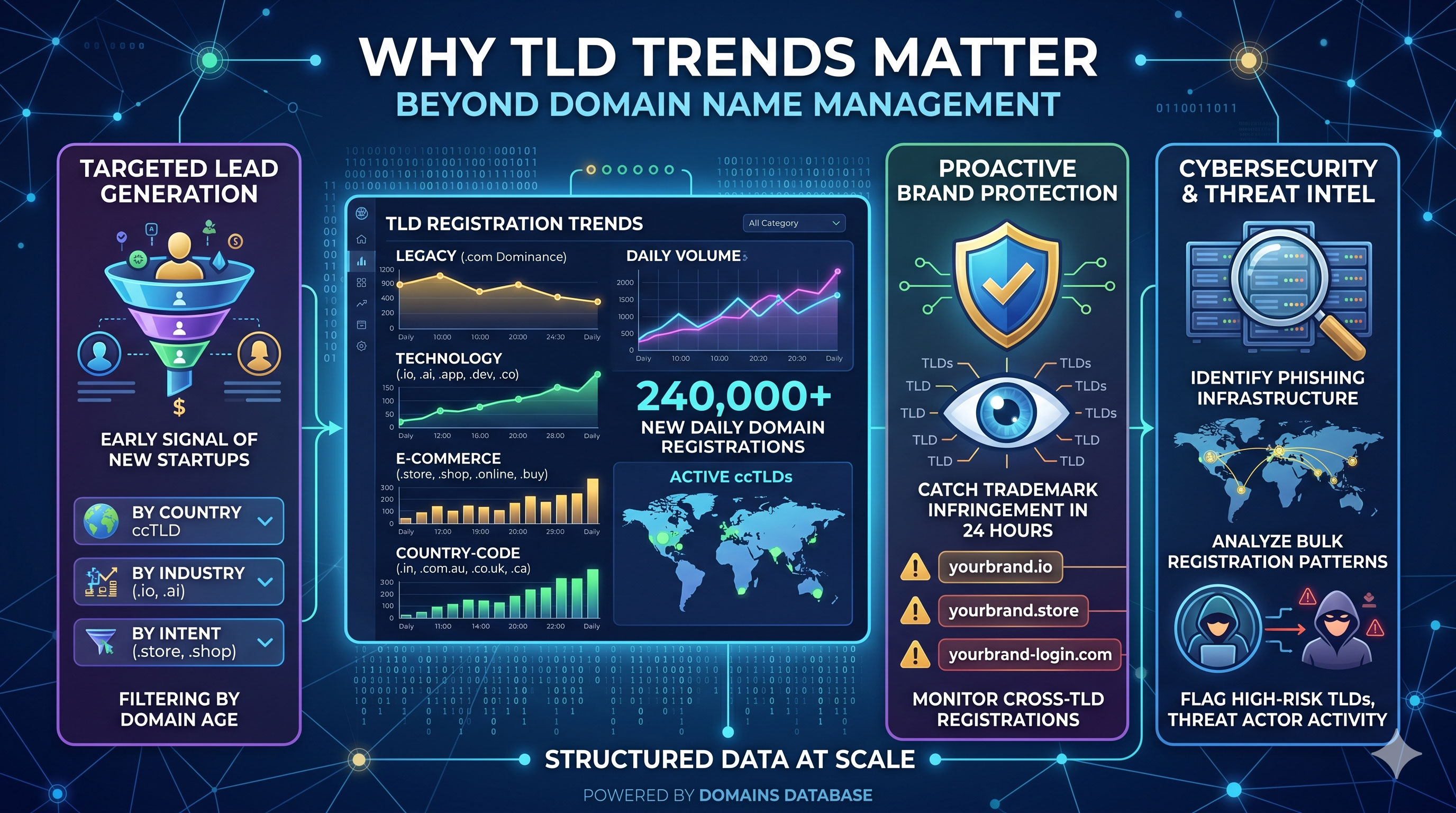
The daily domain feed consistently captures 240,000+ new domain registrations each day. This volume is not evenly distributed. A handful of legacy TLDs account for the majority of registrations, while hundreds of newer TLDs capture small but strategically significant slices of the market.
Legacy dominance: .com continues to account for the largest share of daily registrations by absolute volume. This reflects both its default status for global businesses and its value as a protected asset for large organisations. For businesses targeting truly global audiences, .com acquisition and monitoring remains high priority.
Country-code TLDs showing consistent growth: Country-code TLDs (ccTLDs) have matured into trusted local-market assets. .in (India), .com.au (Australia), .co.uk (United Kingdom), and .ca (Canada) show strong, consistent registration volume - and these are the TLDs where country-specific WHOIS databases are most valuable because registrant contact data is more frequently published.
Technology and startup-focused TLDs: Extensions including .io, .ai, .app, .dev, and .co have established themselves as credible alternatives to .com in the technology sector. Startup founders and developer-focused companies frequently choose these extensions. If your business targets the technology sector, monitoring new registrations in these TLDs gives you an early signal of new entrants.
E-commerce intent signals: .store, .shop, .online, .buy, and similar extensions attract registrants with explicit commercial intent. Registration spikes in these TLDs often correlate with seasonal retail planning cycles.
Using TLD Data for Lead Generation
The Domains Database complete list gives you access to the full historical catalogue of domains by TLD. For lead generation teams, filtering by TLD is one of the most effective first-pass segmentation methods:
- Target by country: If you sell a product or service that only ships domestically, filtering to your country's ccTLD eliminates irrelevant international leads immediately.
- Target by industry signal: If you sell cloud services or developer tools,
.ioand.airegistrations are worth monitoring daily. If you sell e-commerce software or payment processing,.storeand.shopare relevant. - Target by intent stage: Brand-new registrations (from the daily feed) represent the earliest stage. Looking at the complete domain list with registration date filtering lets you target domains that are 30, 60, or 90 days old - past the initial setup chaos but still in the early growth phase where service spending decisions are being made.
Using TLD Data for Brand Protection
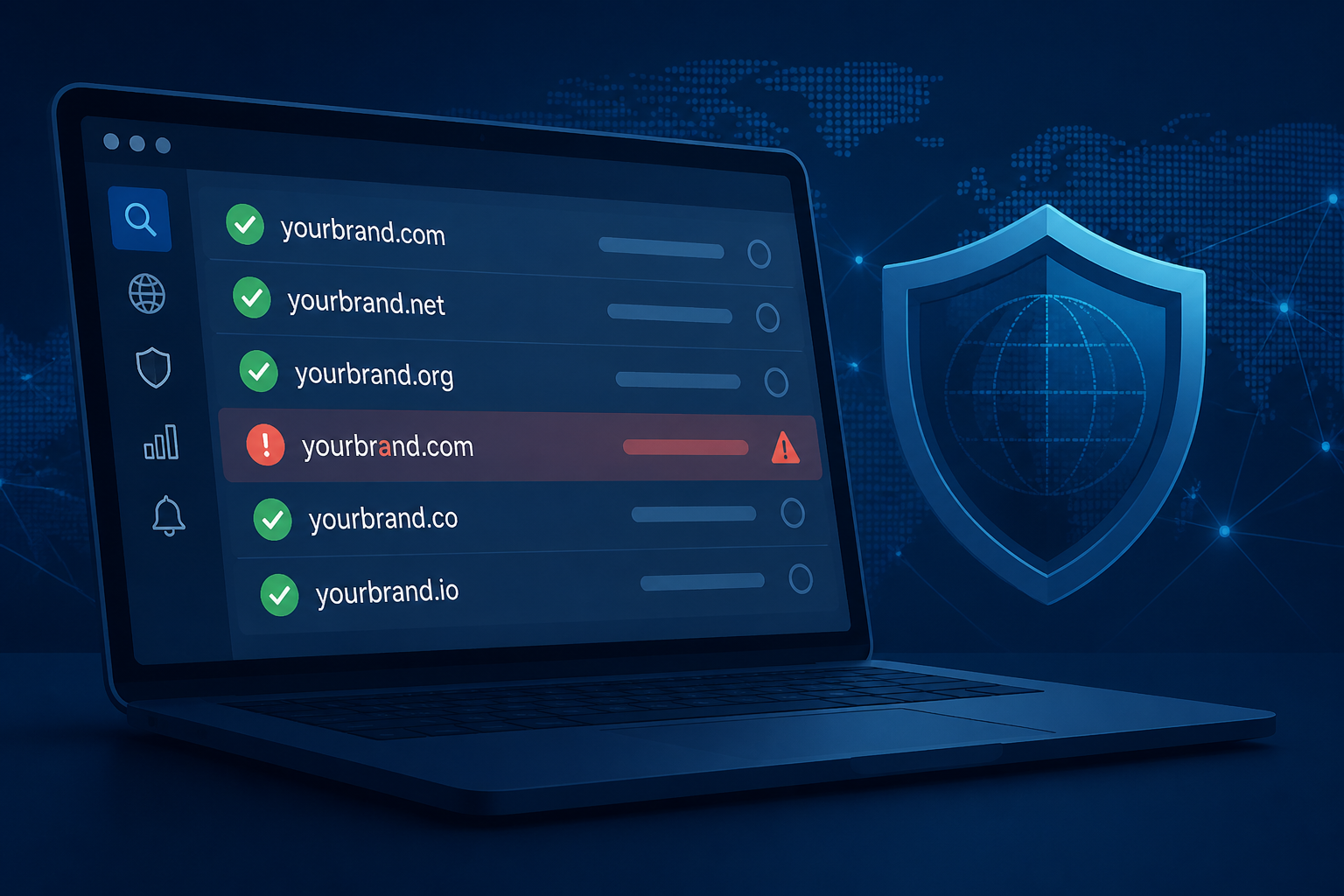
Trademark-infringing domain registrations typically expand across TLDs. A bad actor registering a domain that mimics your brand will often register it across .com, .net, .org, and multiple ccTLDs simultaneously to maximize reach or resale value.
Monitoring daily new registrations for domains containing your brand keywords - across all 1,601 TLDs - is how brand protection teams catch these registrations within 24 hours of the event. The brand monitoring use case describes this workflow in detail.
Using TLD Data for Cybersecurity Research
Domain infrastructure used for phishing, malware distribution, and spam campaigns typically uses newly registered domains registered in bulk. Patterns that are invisible when looking at a single domain become clear when analysing thousands of records:
- Sudden registration spikes in specific TLDs
- Clusters of domains registered through the same registrar on the same day
- Name patterns (keyboard-walk domains, brand-lookalike patterns, dictionary combinator patterns)
The cybersecurity use case covers how security teams use domain feeds as part of threat intelligence pipelines. For individual domain checks, the free WHOIS Lookup Tool and DNS Health Checkup Tool provide on-demand research capability.
Accessing the Data
The Domains Database is available in several formats:
- Daily free list: A daily sample of new domain registrations available at no cost
- Daily API: Full daily feed with 240,000+ registrations across 1,601 TLDs, delivered via API as a zipped CSV
- Complete list download: The full historical database for offline analysis
- Newly registered domains API: Structured API access to the daily new registration feed
Pricing for all options is on the pricing page. For custom data requirements or questions about volume and filtering, contact the team.